Published September 3, 2026
Mortgage rates just jumped. What does that actually mean for San Antonio buyers and sellers?


Mortgage rates just jumped. What does that actually mean for San Antonio buyers and sellers?
Rates went up. Again. Here is the math on what that does to a $500,000 house — and why it lands on the seller just as hard as the buyer.
What actually happened this week
Freddie Mac put the average 30-year fixed mortgage rate at 6.71%, up from 6.66% the week before — the highest weekly average in more than a year. Daily rates actually touched about 6.91% on Wednesday.
You know who that sucks for? Buyers. But also sellers — because every time rates move higher, the exact same house gets more expensive for the buyer. Let me show you what I mean.
Same house. Different payment.
Let's use easy numbers. Say you're buying a $500,000 home with 5% down — a loan amount of roughly $475,000.
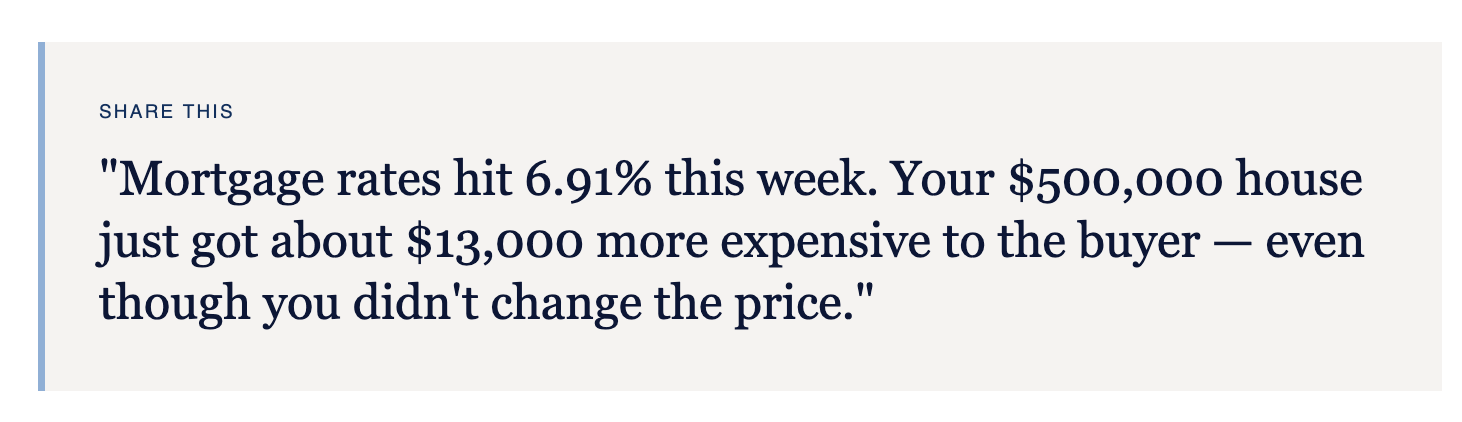
At 6.66%, principal and interest runs about $3,052 a month. Move the rate to 6.91% and the same loan on the same house costs about $3,132 a month. Same kitchen, same yard, same school district, same everything.
That's roughly $79 more every month, about $950 more a year, and somewhere near $28,000 more over 30 years if the buyer keeps the loan and never refinances. Nothing about the house changed. The cost of buying it did.
Here's another way to look at it
At 6.66%, our buyer could carry that $500,000 home at about a $3,052 payment. If that same buyer wants to keep roughly the same payment at 6.91%, the price has to come down.
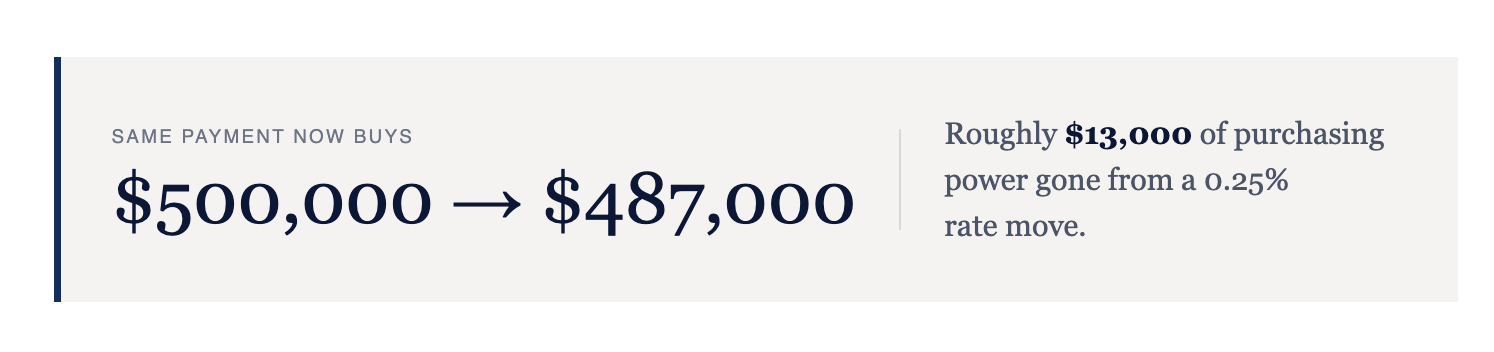
Same buyer. Same income. Same monthly budget. Interest rates changed the math.
Why this is the seller's problem too
This is where sellers sometimes get frustrated with me. They hear "rates went up" and think: okay, that's the buyer's problem.
Unfortunately, it becomes your problem too. The buyer isn't shopping your list price. They're shopping the answer to one question:
"What is this house going to cost me every month?"
And when rates rise, your house just got more expensive to every financed buyer looking at it.
Lever one: the price
I know. Nobody wants to hear that. But think like a buyer for a second. If a home was more affordable last week and rates just pushed the payment higher, why would that buyer suddenly be excited to pay the same asking price today?
Something somewhere has to give. It could be the interest rate. It could be the buyer's expectations. Or it could be the seller's price. And in a buyer's market with a lot of inventory, "well, that's my price" carries less weight — because the buyer can swipe to the next house.
Lever two: concessions
Don't want to touch the price? Fair. Price isn't your only lever. You can get a lot more flexible on concessions instead:
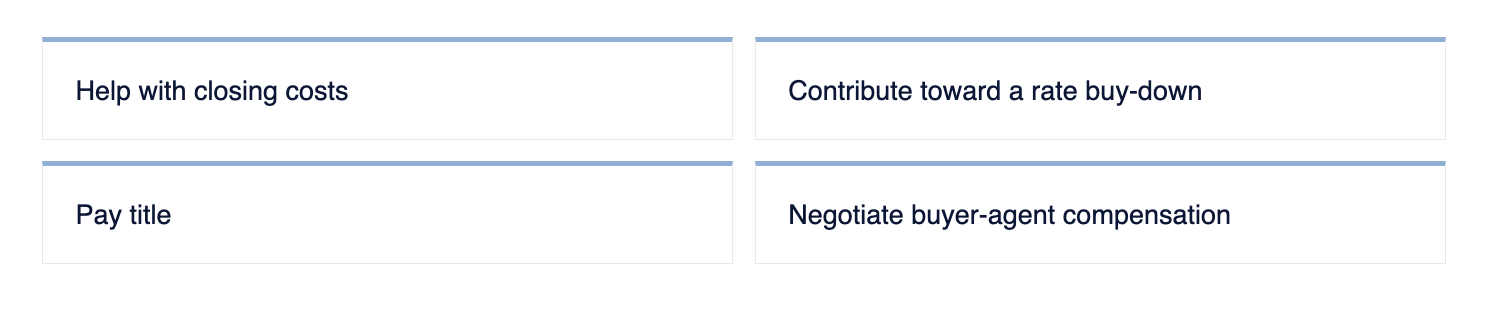
And here's where I'll challenge some sellers. Don't be the seller who refuses everything. Not paying closing costs. Not paying their agent. Not paying title. Not giving them anything. You can absolutely take that position — just understand the market you're taking it in. Right now buyers have choices, and choices create leverage. That may suck. The market does not particularly care whether we like it.
"What if I just wait for rates to come down?"
You can. Maybe rates come down, and affordability improves. There's nothing wrong with waiting if you have the ability to wait.
But here's the kicker: you aren't waiting by yourself. Thousands of other sellers are competing for the same buyers. And if one of them says "rates went up — let's offer $10,000 toward a buy-down," or "let's adjust $15,000," or "sure, we'll help with closing costs" — guess which home suddenly looks more attractive.
Theirs. You don't compete against the market in theory. You compete against the house down the street.
This is why sellers have to think like buyers
Take your seller hat off. Pretend you're buying your home today, and you like two houses.
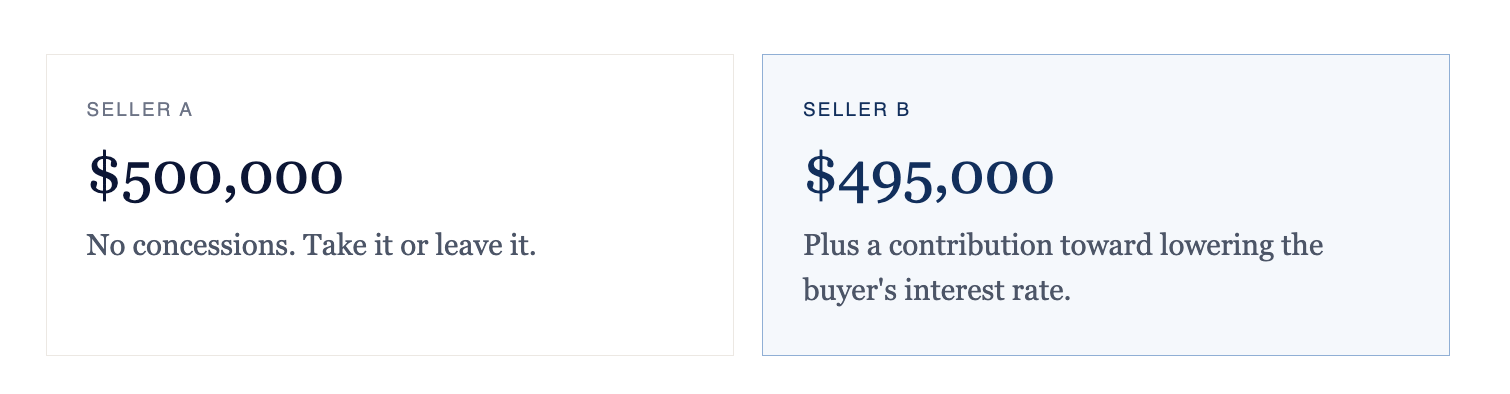
This doesn't mean you give your house away. It means you understand what the buyer on the other side of the table is experiencing — because their payment just got more expensive.

So yes, rates went up. Now what?
For buyers, it means less purchasing power and higher payments. For sellers, it means the pool of buyers who can comfortably afford your home just got a little smaller.
That's not a reason to panic. It's a reason to adjust. Talk to your agent. Look at your competition. Look at your showing activity. Talk through pricing, concessions, and whether a temporary or permanent buy-down could help — then pick the lever that gives you the best chance of getting sold.
Because in this market, stubbornness is not a strategy. You don't have to give your house away. But you do have to give today's buyer a reason to choose it.
One more thing worth holding onto: Freddie Mac noted that purchase demand has stayed relatively stable despite higher rates. Buyers haven't vanished. They're adapting and still shopping.
Payment figures are principal and interest only, rounded, and shown for illustration — taxes, insurance, and mortgage insurance are not included. Rate data: Freddie Mac Primary Mortgage Market Survey. Not a loan commitment or an offer to lend.